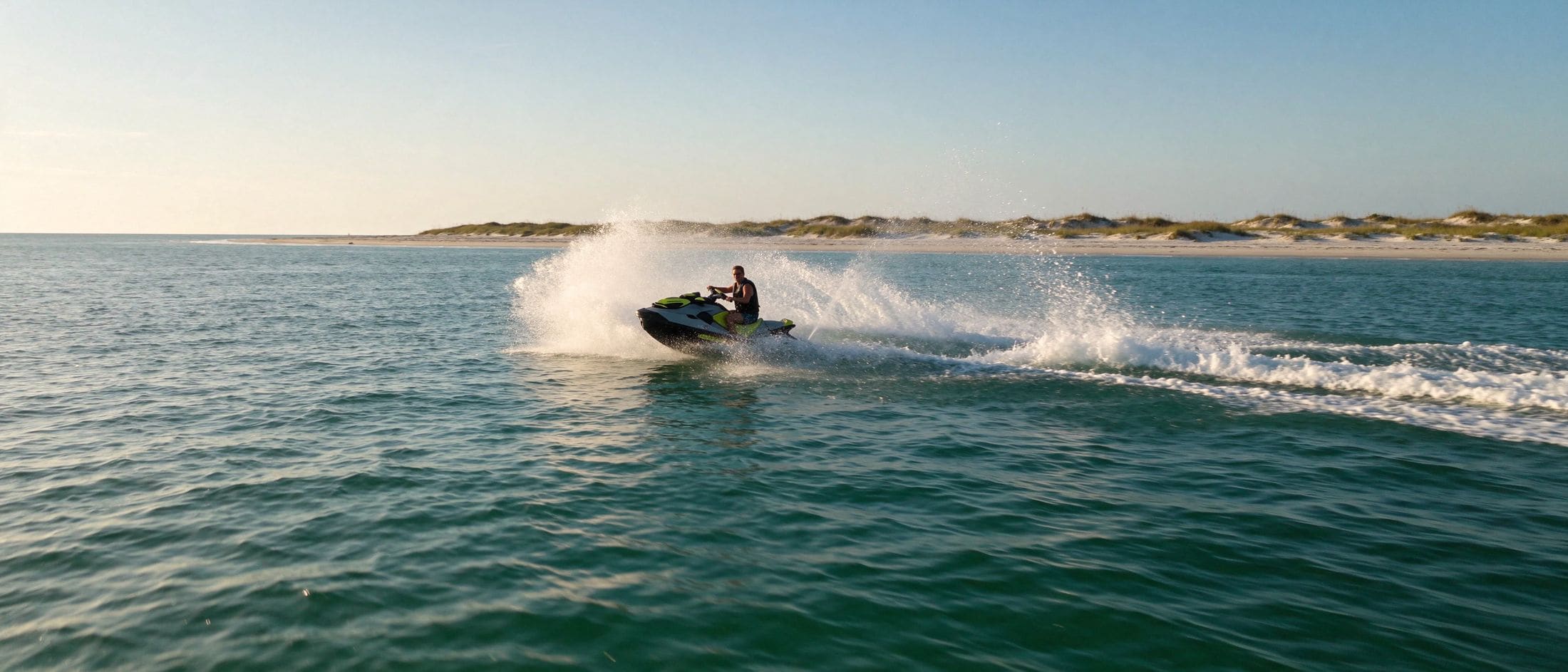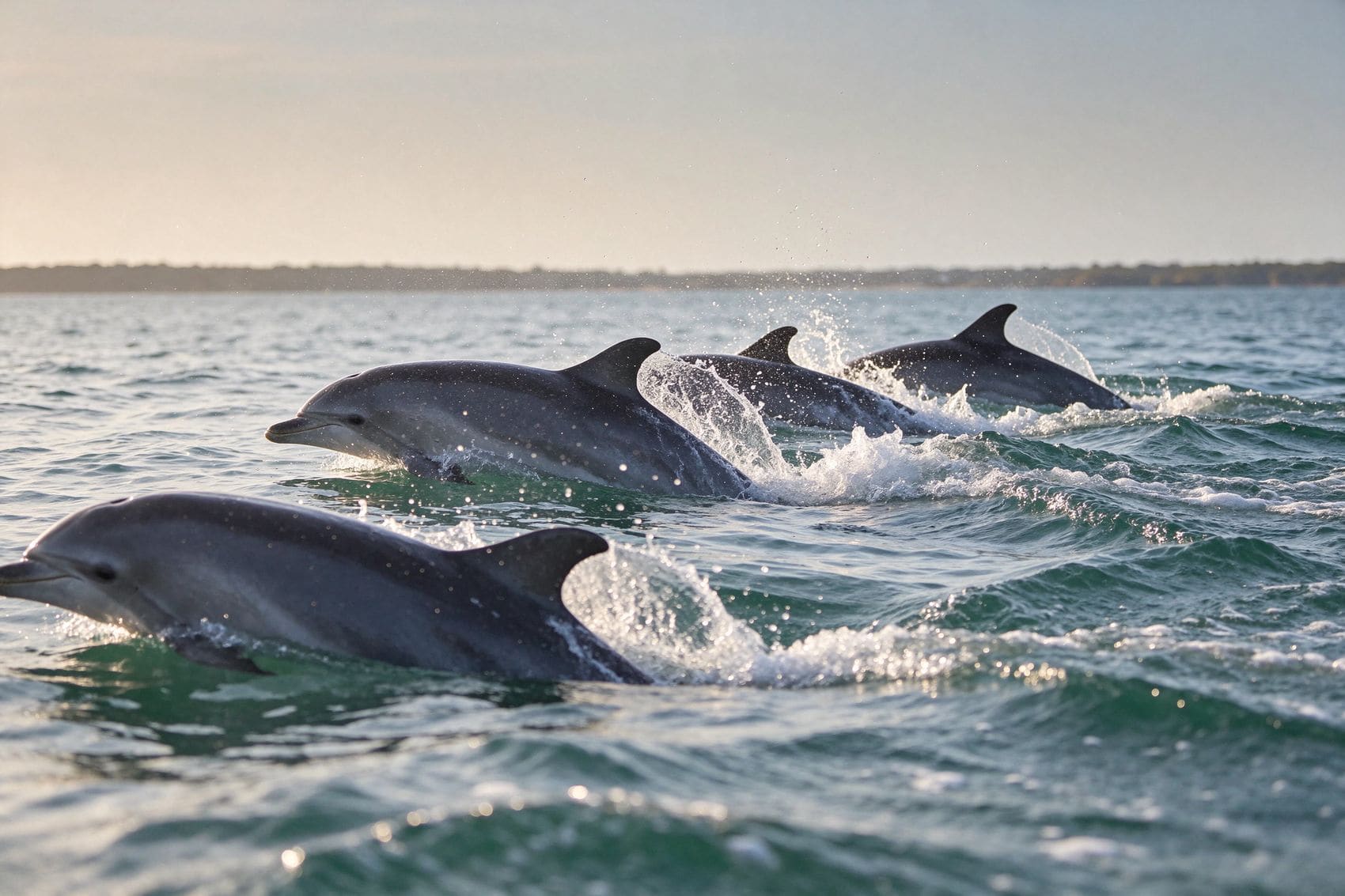
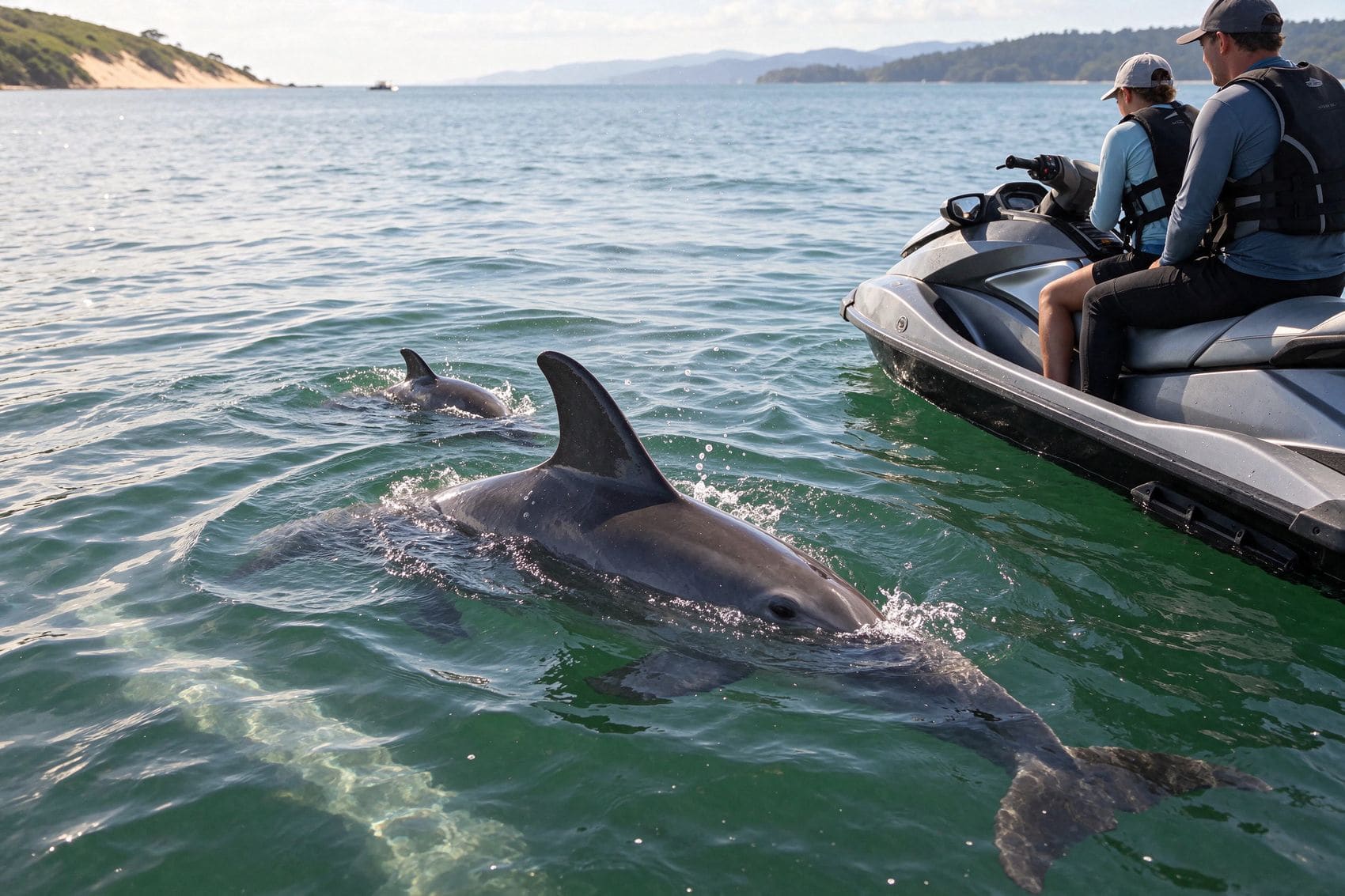
The guide raises a fist and six engines drop to idle, then to nothing. The bay goes quiet enough that you can hear water slapping a hull. Thirty yards off the bow a dorsal fin cuts a slow line, then another behind it, then a third that is half the size of the others. Nobody says anything. A kid on the back of the nearest ski points with a whole arm, and that is the correct response.
Why a jet ski is a good platform for this
You are sitting maybe two feet above the waterline. No cabin, no diesel thrum, no deck full of people talking over a loudspeaker. When a dolphin surfaces beside you, you are at its eye level, and the ski is small enough that it does not read as a ship. That proximity is the entire reason people book this instead of a bigger boat.
It also means you are responsible for the distance. A boat with a captain keeps the rules for you. On a ski, the etiquette is yours to hold, which is why the briefing spends time on it.
What we do when a pod shows up
Cut the throttle. Coast. Do not turn toward them, do not speed up to get ahead, and do not circle. A jet ski that changes course toward a dolphin is a jet ski chasing a dolphin, whatever the intention was.
- Throttle off, engine idling or dead, and drift
- No course change toward the animals, ever
- Never cut between a mother and a calf
- Hands off. No touching, no feeding, no dangling a hand in the water as an invitation
- If they change behavior, you back off: a pod that dives and disappears has told you something
There is no magic number of feet that makes an encounter responsible. The animals tell you. Curious dolphins will close the distance on their own terms, sometimes close enough to raise the hair on your arms. Montana: "we had dolphins within 2 feet of our ski on our free time." That happened because the ski was stopped, not because the ski was fast.
Reading a pod
Three behaviors, three responses. Feeding dolphins circle and change direction, often over a patch of stirred-up sand, with birds working above. Travelling dolphins surface on a steady rhythm and go somewhere; they will ignore you. Resting dolphins surface slowly, dive long, and want to be left alone.
Feeding pods are the ones worth idling near, at a distance, because they stay put and the show is continuous. If there is a calf in the group, double the room you give. CJ described the version of this that stays with people: "He guided the group out to the gulf and we got to watch a pod of dolphins swim directly under our skis." Under the skis, not beside them, and entirely the dolphins' decision.
The two hours around the encounter
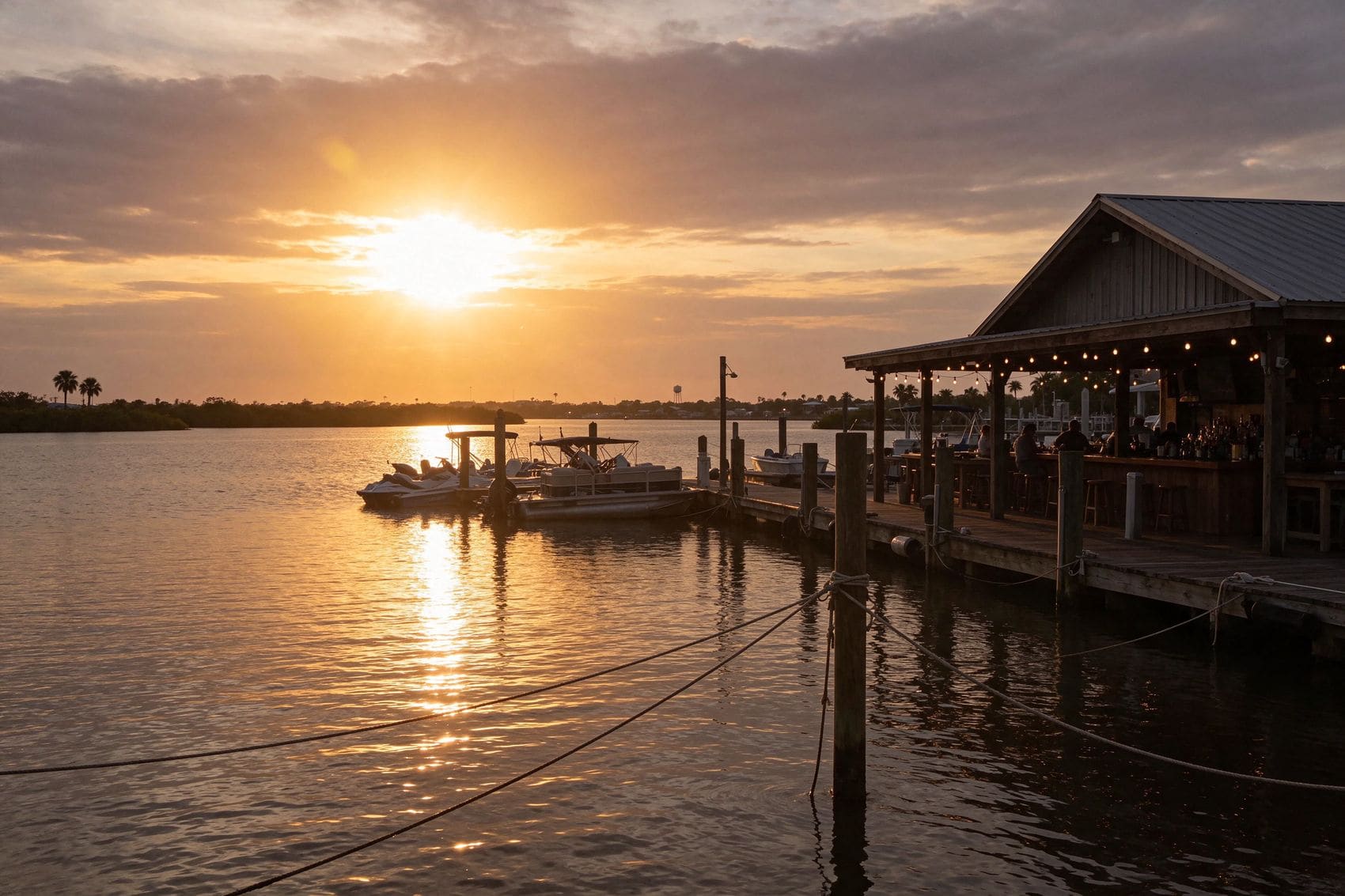
The encounter is not the whole tour, which is why it does not feel rushed. The guide leads for about 45 minutes through St. Andrews Bay and into the Gulf when conditions allow, working the water where dolphins feed. Then the group beaches at Shell Island, 700 acres of undeveloped barrier island about 10 minutes from the dock, to swim and pick up shells. After that you get roughly an hour of free riding at your own pace, with the guide regrouping everyone about 15 minutes before the end.
That free hour is when a lot of guests see their best dolphin moment, because a stopped ski in the right water is more attractive than a moving one. It is also when the temptation to chase is strongest. Resist it. A dolphin that leaves because you gunned it is a dolphin nobody in the group sees again.
Watch the water, not the horizon. A dolphin surfaces for a second or two, so the useful skill is spotting the slick it leaves behind, a flat patch of water where the surface has been pushed down. Follow the slicks and you can track an animal you never see breach.
No promises, and why that is fine
Dolphins are wild. They move, they feed on their own schedule, and no operator on this coast can guarantee a sighting. What we can tell you is where they feed, and that we go there first rather than hoping. Some mornings it takes ten minutes. Some mornings the guide works three spots and the group ends up swimming at Shell Island instead.
The $129 covers the boat, the fuel, the guide, the life jackets, the route map and the instruction, per ski for two riders. It does not buy a dolphin. It buys you the best odds we know how to arrange, and a guide who will cut the engine when the odds pay off.
Book the partially guided dolphin tour for a morning slot, or call (850) 541-6879 to ask what the water has been doing this week. Bring a dry bag, leave the phone down for ten minutes, and let the pod make the first move.