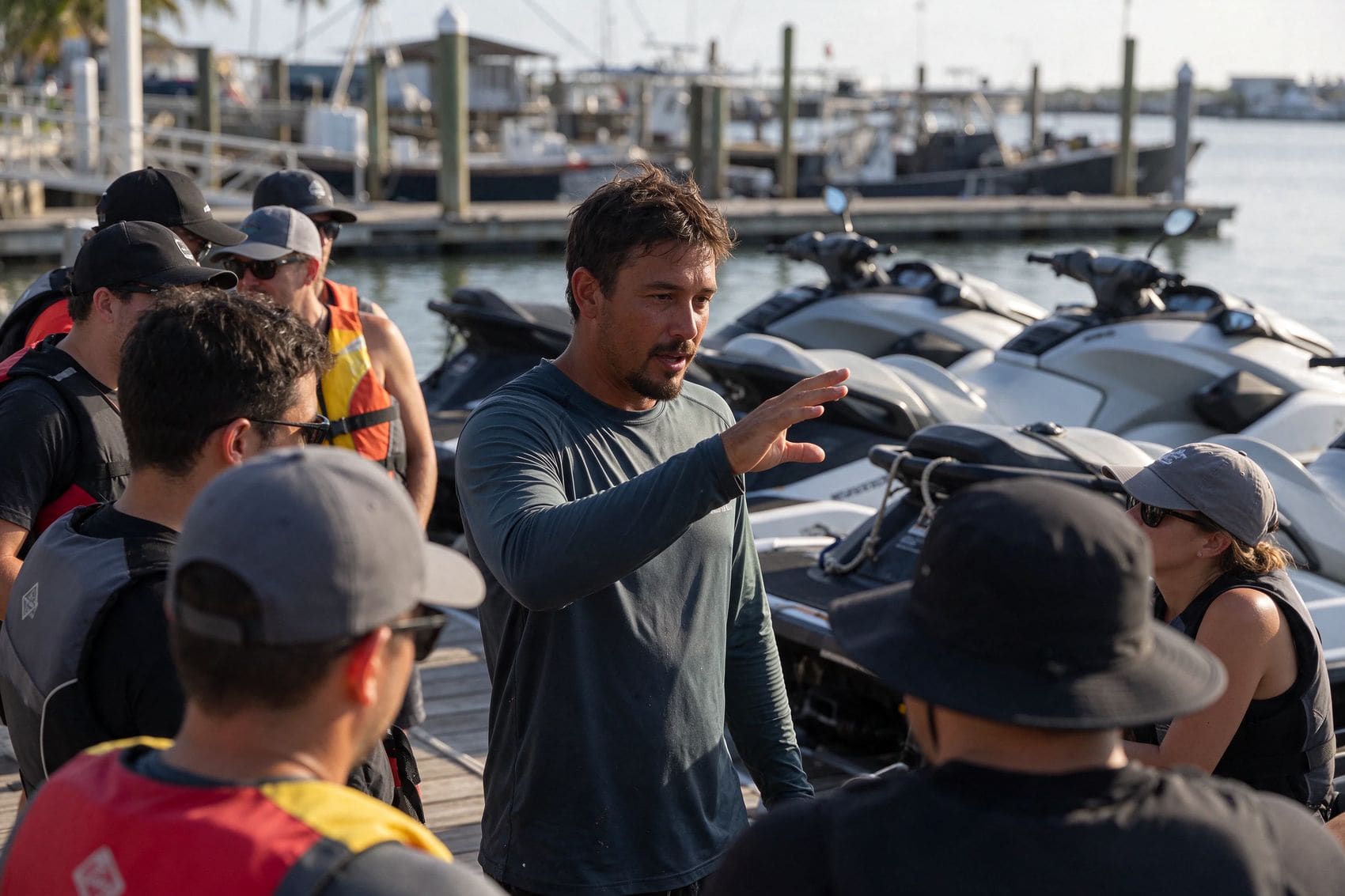
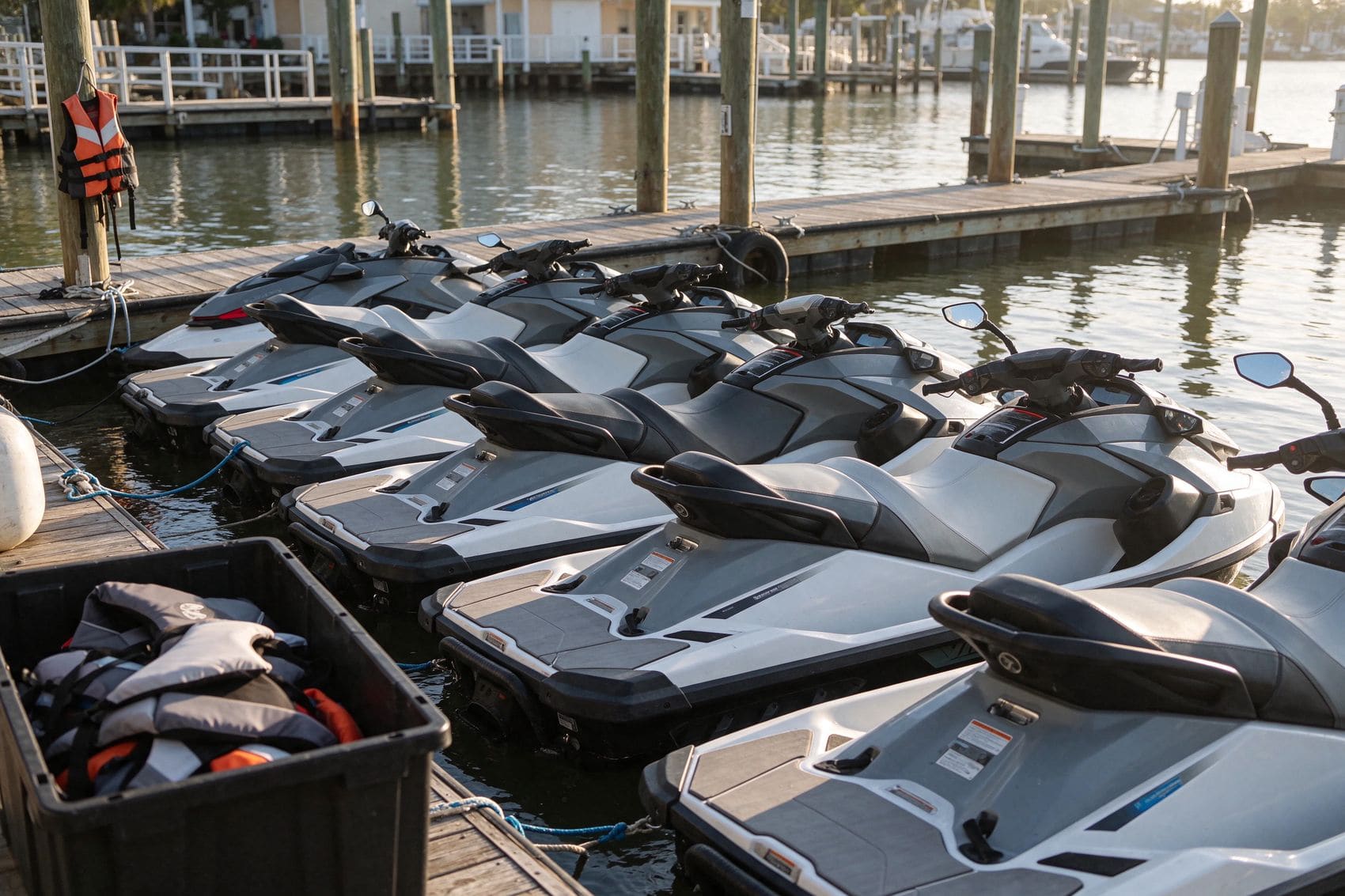
Almost every problem we see on the water was decided on the dock: a life jacket zipped over a t-shirt instead of snug, a lanyard still in a cupholder, a rider who did not know that letting off the throttle also stops the steering. Ten minutes of attention at the dock removes most of it. Here is what that ten minutes covers.
Before the engine starts
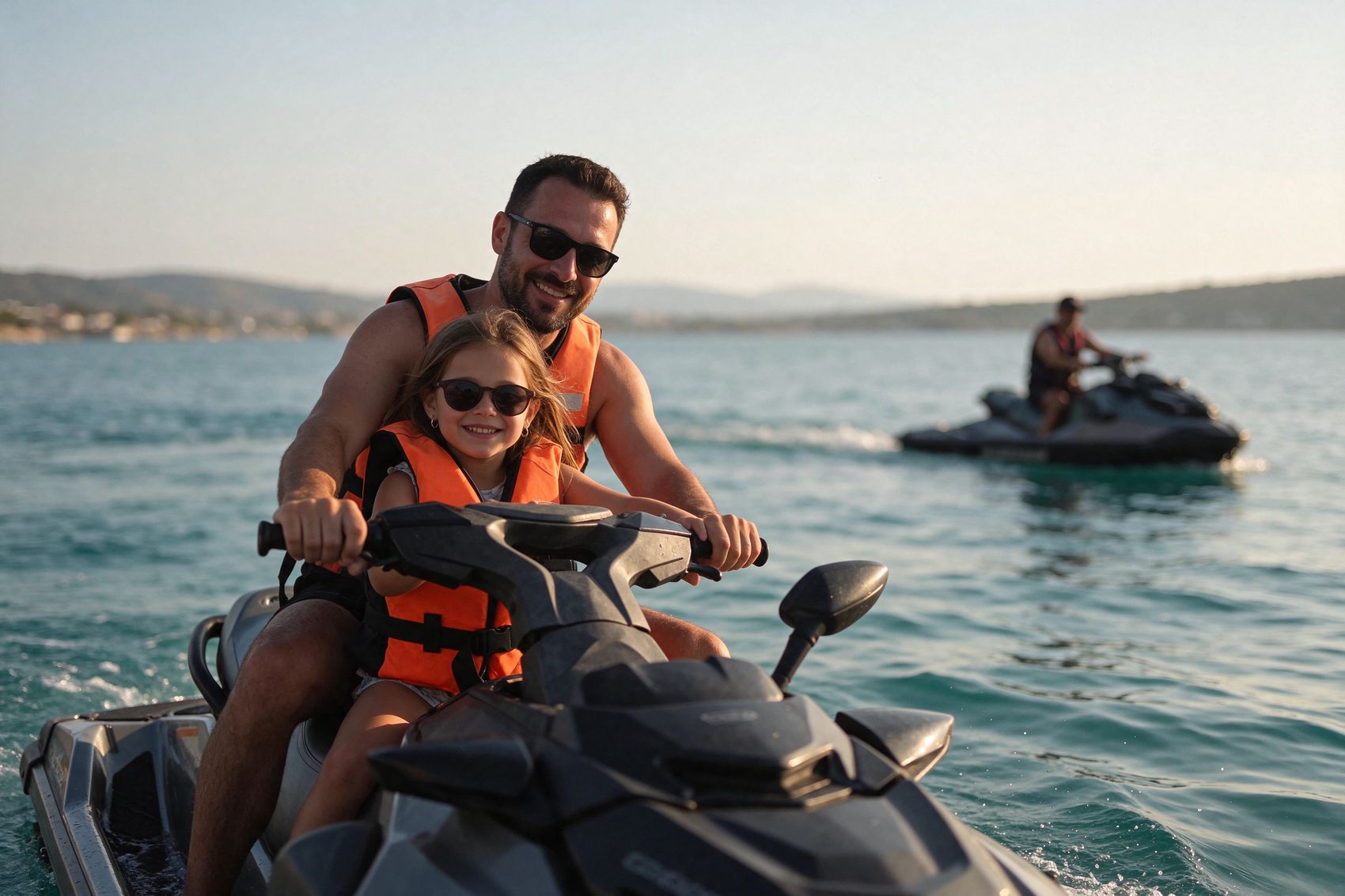
Life jacket on and clipped, snug enough that pulling up on the shoulders does not lift it past your ears. Lanyard clipped to the jacket, not looped on a wrist and not in a pocket. Both riders briefed on who is driving. Phone in a dry bag or the compartment, not in a hand.
Then the walk-around: check that nothing loose is sitting on the seat, because a towel at 30 mph becomes a projectile. Fuel is included in every rental and every tour, so there is nothing to buy at the dock. Arriving 30 minutes early is part of safety, not paperwork: it is the difference between a rushed briefing and a real one.
The lanyard is the whole safety system
Clip it to your jacket. If you come off, the cord pulls and the engine dies, which means the ski stops instead of continuing across the bay without you. That single piece of plastic is why a jet ski is safer than it looks.
Reboarding happens from the rear, never the side. Swim to the back of the ski, take the handle, and pull yourself up while the engine is off. Practise the motion once at idle near the dock if you have never done it. It is much easier when the water is calm and much harder when it is not.
Right of way, in plain words
You are the smallest fast thing out there, so you give way more than you take.
- Vessels crossing: the one on the right has the right of way. If someone is on your right, you yield
- Sailboats under sail, paddleboards, kayaks and swimmers: give them room and slow down early
- Head-on: both turn starboard, so you pass port to port
- Being overtaken: hold your line and your speed, let them go around
- Docks, ramps and moored boats: idle speed, no wake, always
Spacing matters as much as direction. Following another ski ten feet off its tail means you react to their mistakes instead of reading the water. Leave two or three lengths and you can see around them, which is the whole point of following at all.
Two habits prevent most collisions. Look over your shoulder before every turn, because a jet ski turns faster than anyone behind you expects. And do not jump the wake of a passing boat close behind it. That is how riders end up in the water beside a prop.
No-wake zones and the marina
We launch from a marina at Papa Joe's Bayside, not a beach, and that is a safety feature as much as a convenience. There is no surf break to punch through and no crowded public ramp. It also means the first two minutes are idle speed: no wake past the docks, out through the marked channel, then throttle once you are clear.
Posted no-wake zones exist because of docks, shallow water and small boats. Idle through them. A wake that looks like nothing from the saddle rolls a pontoon tied at a dock.
Wind, chop and the captain's call
Weather here turns on wind direction. Wind with tide is a pleasant chop. Wind against tide at the pass stacks water short and steep, and that is when the Gulf leg gets dropped and the bay becomes the whole route. The captain decides, every morning, and the decision is not a negotiation.
Afternoon is the usual problem. The sea breeze fills in, the bay picks up a texture, and the ride home is wetter than the ride out. Morning slots are calmer, the light is better for spotting fins, and the wind has not had all day to build.
If we cancel, you reschedule or get a full refund. If you cancel with 24 hours' notice, full refund; same-day cancellations are non-refundable, and a late arrival or no-show forfeits the reservation. Once you have departed, there are no refunds. Read that twice before you book a 9am slot after a late night.
What is on the ski, and what is not
Every rental and tour includes fuel, life jackets, all safety equipment, a route map, and a full orientation. The guided tour adds a local guide and instruction built for first-timers. What is not on board is drinking water, sunscreen, or a second chance at a life jacket that does not fit, so sort those at the dock.
Capacity is two riders and 350 pounds combined. The driver must be 18 or older with a valid license on the tour, 21 or older on an unguided rental. Passengers 5 and up are recommended.
Book the guided dolphin tour and the briefing comes with a guide who will watch you ride, or call (850) 541-6879 with questions about conditions before you pick a day.